A critical part of addressing a problem of practice in community engagement is identifying the root causes before trying to solve the problem. The Five Whys Protocol helps teams uncover underlying causes by drilling down into the reasons.
Materials
Five Whys Template
Timeframe
30 Minutes
Preparation
Facilitators should make a poster-size copy of the Five Whys Protocol Template or share an electronic copy with the group members. See the resources section below for a fillable electronic copy of the template. If multiple groups are working on different problems of practice, each group should have a copy of the Five Whys Protocol Template.Virtual Implementation:
Use the electronic template, ensuring all have access to edit the document.
Use breakout rooms to create a space for separate teams to work.
Instructions
Step 1:
Introduce Protocol Share the following information with participants:
When a problem of practice has been identified, it is essential to understand the root causes of the problem. We often find ourselves jumping into solutions that may or may not address what is causing a problem.
The Five Whys is a simple problem-solving technique that helps to get to the root of a problem quickly. It involves looking at any problem and drilling down by asking: “Why?” or “What caused this problem?”
While you want clear and concise answers, try to avoid answers that are too simple and overlook important details. Typically, the answer to the first “why” should prompt another “why,” and the response to the second “why” will prompt another, and so on; hence the name Five Whys.
This protocol can help quickly determine the root cause of a problem. It’s simple and easy to learn and apply.
As a group, we will come up with ideas about what is contributing to the problem of practice. All voices should be heard as the team answers our Why questions.
Step 2:
Five Whys Protocol Process
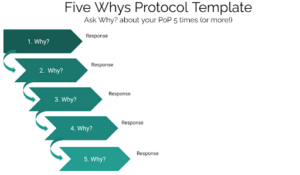
Write the problem (PoP) statement identified by the group at the top of the Five Whys Protocol template (or poster).
Facilitator asks why the problem of practice exists or happened and records the group’s response.
Facilitator asks the group to consider the following, “If this response were corrected, is it likely the problem would still exist?” If the answer is yes, the response is a contributing factor, not necessarily a root cause.
If the response is identified as a contributing factor, the facilitator should continue the process by asking “Why” about the response. Record the group’s response and continue with the process, asking why about each subsequent Why response until the group agrees the root cause has been identified.
Validate the root cause by gathering additional information and input from community members as needed. Ask the group if the root cause was removed would the problem be resolved. A consensus decision-making protocol, such as “Getting Consensus with Thumbs,” can be used to reach agreements in this protocol.
The group should examine how the identified cause(s) aligns with the Dual Capacity-Building Framework Essential Conditions and the Six Root Causes of Ineffective Family Engagement (see Resources).
The Five Whys Protocol TemplateNote: This protocol and the Fishbone Root Cause Analysis protocol are crucial components of the Problem of Practice cycle. Starting with the Five Whys and moving into the Fishbone often provides clear root causes.
Step 3:
Changes / Strategies Analysis
Individually, group members should list changes or strategies to address an identified root cause.
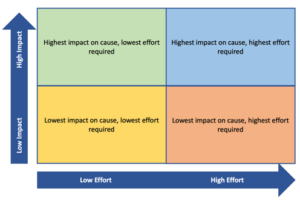
As the strategies are shared, they should be placed on the Impact and Effort Matrix for analysis and discussion. An electronic matrix is included with the Five Whys Protocol Template, or a poster can be created for the group.
Following the analysis of the changes or strategies with the Impact and Effort Matrix, the group can move into the next phase of the Problem of Practice Protocol and begin to plan and implement the changes or strategies.
Larger groups can be broken into smaller teams to complete the protocol, and then the results can be shared with the entire group.
Facilitators can ask participants to complete a Five Whys analysis first; then, each participant can share their results with the group. Based on the shared individual responses, the group collaboratively goes through the protocol, reaching a consensus on the root contributing factors and root cause.

 Note: This protocol and the Fishbone Root Cause Analysis protocol are crucial components of the Problem of Practice cycle. Starting with the Five Whys and moving into the Fishbone often provides clear root causes.