A practical, interactive companion to CEI's story, framework, and two-year Learning Journey, built for LEAs, county offices of education, and community partners building authentic partnerships across California.
Part of the California Statewide System of Support
Section 1 · Welcome and Purpose
Why this Field Guide exists
Across California, there's growing agreement on something easy to say and hard to do: students do better when schools and communities work as true partners. Yet for many years, community engagement has been treated as a requirement rather than a practice. Meetings are held, input is collected, and plans are written, while many students, families, and community members still feel unheard or invited too late to shape real decisions.
That gap is exactly what the Community Engagement Initiative (CEI) was created to address. CEI brings together students, families/caregivers/guardians, educators, district and county leaders, and community partners to build the relationships, skills, and structures needed to engage more relationally, more inclusively, and more connected to student learning and well-being.
"CEI is not a one-off program or a short-term campaign. It has grown into a statewide learning community."
This Guide is designed to:
✓Provide a clear story of CEI and why it matters
✓Offer shared language and definitions for the work
✓Explain CEI's framework and learning journey in plain language
✓Support teams in adapting the work to local context, keeping community voices at the center
CEI's Mission
Build the conditions for meaningful, inclusive, and effective community engagement across California's education systems, grounded in the belief that communities bring valuable racial, cultural, linguistic, and lived-experience assets that are essential, not "extra," to designing schools that truly serve students.
Section 2 · Why Community Engagement Matters
The engagement gap in California
Policies like the Local Control Funding Formula (LCFF) and Local Control and Accountability Plan (LCAP) were designed to elevate the voice of educational partners. But as they were implemented statewide, a persistent gap became clear: many LEAs lacked the structures, shared language, and trust-based relationships needed to engage communities meaningfully.
Engagement often became compliance driven. Meetings were held and feedback was collected, but decisions had already been made. For students and families, particularly from historically marginalized communities, this reinforced a sense of exclusion: voice was invited, but power was rarely shared.
Meaningful engagement requires:
✓Skills to facilitate and host necessary conversations
✓Systems that value lived experience alongside professional expertise
✓Time and structures to build trust before decisions are made
✓Shared understanding of what "engagement" means in practice
Without these conditions, even well-intentioned efforts can unintentionally cause harm, reinforce mistrust, or silence voices that already struggle to be heard.
Section 3 · CEI's Evolution and Statewide Role
From CEI 1.0 to CEI 2.0
CEI 1.0 · 2018
Building the foundation
CEI began by bringing together professional learning networks focused on improving local student outcomes and community engagement, prompted by an assessment of LCAP engagement practices across the state. This first phase established the peer learning model that still defines the work.
Co-administered by CCEE and the San Bernardino County Superintendent of Schools (Lead Agency) Lead agency partners: Families in Schools and the California Association for Bilingual Education (CABE)
CEI 2.0 · 2022
Expanding statewide
CEI 2.0 expanded the work, deliverables, and scope of the initiative, extending its operational timeline through the end of the 2028-29 school year. The second phase deepened the emphasis on leadership, capacity-building, and alignment across California's Statewide System of Support.
Co-administered by CCEE and the San Diego County Office of Education (Lead Agency) Lead agency partners: Eskolta School Research and Design and the University of San Diego (School of Leadership and Education Sciences)
Leadership & Statewide Alignment
CEI 2.0 is co-led by a statewide partnership that brings expertise in education improvement, research, and community-centered design:
A defining feature of CEI is its peer-led learning model. Experienced participants, known as CEI alumni facilitators or PLLX (Peer Leading and Learning Exchange), support learning spaces and mentor teams applying the work locally. Capacity is best built through relationships and shared learning, not top-down mandates.
Section 4 · How CEI Defines Community Engagement
A shared definition
"Authentic partnerships between students, families/caregivers/guardians, schools, and communities grounded in equity, built on trust, and nurturing relationships that lead to positive student outcomes."
Authentic partnerships
Goes beyond listening sessions or feedback collection. Community members have real opportunities to influence priorities, decisions, and solutions.
Grounded in equity
Recognizes that not all communities start from the same place; engagement must address power, access, language, and historical exclusion.
Built on trust & relationships
Engagement happens early, consistently, and with transparency, not only when decisions are underway.
Focus on student outcomes
Directly connected to learning and well-being, not treated as a separate effort.
The Essential Conditions for Authentic Partnership
Direct connection
to student learning and wellbeing
Trust-based
relationships built on consistency and transparency
Collaborative
problem-solving across all partners
Interactive
and participatory engagement, not passive input
Section 5 · The CEI Framework
A layered model, not a checklist
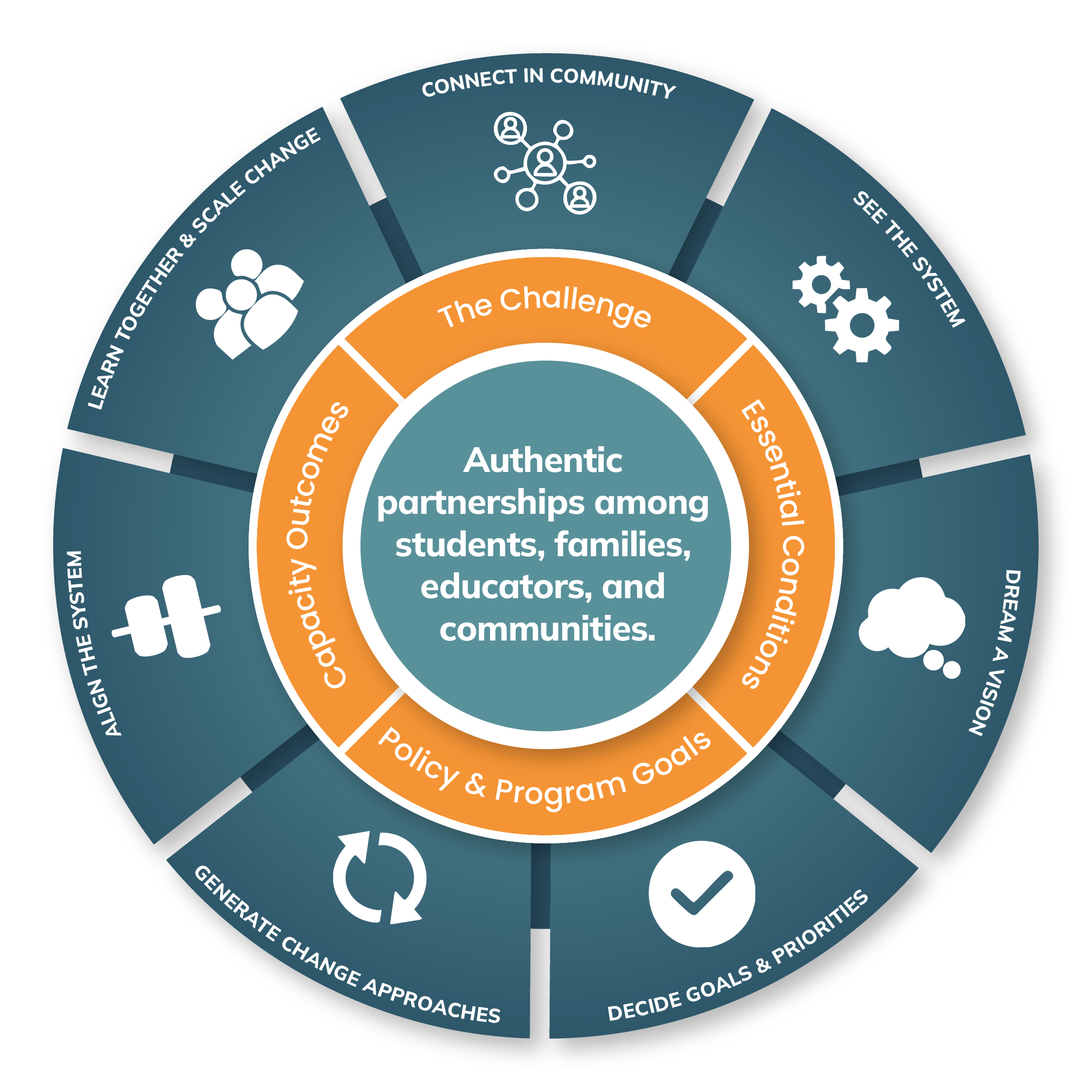
The CEI Framework brings together multiple research-informed approaches to community partnership and systems change. Choose a layer, then a strategy, to explore how each part works.
The CEI Framework
Research Foundations
Dual Capacity-Building Framework (Dr. Karen Mapp). Effective family-school partnerships require capacity-building on both sides, supported by relational trust, shared responsibility, and systemic supports.
Participatory Systems Change for Equity (WestEd and the California Center for School Climate). This approach centers community experience, addresses root causes, and engages those most impacted by inequity as co-designers.
How to use the framework
✓Reflect on where trust and alignment are strong, or fragile
✓Identify which system conditions limit authentic partnership
✓Choose strategies that respond to community priorities
✓Stay grounded in purpose during moments of tension
Section 6 · The CEI Learning Journey
A two-year roadmap to change
Trust takes time. The Learning Journey is a two-year, session-based structure: flexible enough to adapt locally, consistent enough to keep teams aligned. Students travel the same journey as their adult teammates, with sessions designed for student leadership at every stage.
Coming Soon
This is only the beginning. Part 1 introduces CEI's core concepts. Watch for Parts 2 and 3 of the Field Guide for a deeper dive into existing and future projects to expand community engagement across California.
 Part of the California Statewide System of Support